
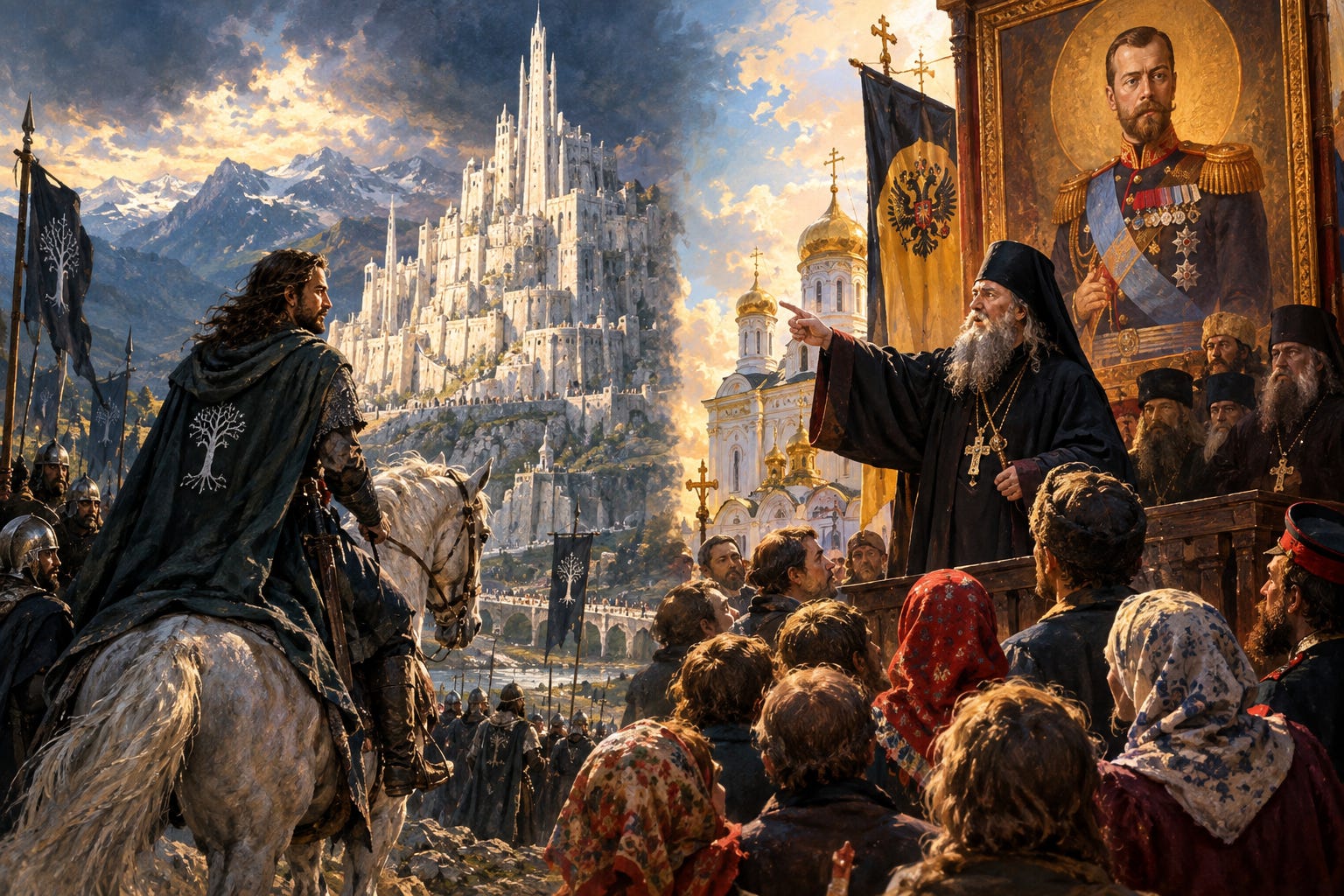
The key sociological proscription by the various flavors of the ideologies of nationalism is the establishment of the only legitimate form of government, the nation-state. This model of government vests the monopoly of power and force alongside the right to rule in this “they” of a state, not in the person of a Sacral Monarch. In the words of Tolkien “government is an abstract noun meaning the art and process of governing and it should be an offence to write it with a capital G or so as to refer to people. If people were in the habit of referring to ‘King George’s council, Winston and his gang,’ it would go a long way to clearing thought, and reducing the frightful landslide into Theyocracy.”1 Across every nation-state experiment from America to France to Germany to England, bureaucratic expansion followed, leading to de facto technocratic rule. They also had a habit of not staying nation-states by quickly forming empires, which underlies the nation-state’s apparent systemic inability to stay national.
In the nationalistic framework, the loyalty one naturally has to one’s people quickly gets channeled by the concept of the General Will into loyalty to the state that is the telos of said General Will. Loyalty to particular persons making up one’s ethnos or nation redirects to loyalty to an impersonal abstraction, the intentional confusion of the two enabling the technocracy of the nation-state to tyrannize the nation whose General Will it supposedly reflects. This rejects the pre-national model of loyalty to an individual sovereign in whom power and sovereignty vest from above, as per St John of Kronstadt “the guardian and protector of Russia after God is Russia’s Sovereign, the Royal Tsar, and without him Russia is not Russia.”2 The Nationalist Westernizers begged to differ, for Russia was made Russian by the culture of the state’s constituent people, not the person of the Tsar nor the Faith that united and established various Slavic tribes into unified ethnic Russians in their view. Likewise on General Will legitimizing the state, St John taught the opposite that “only God can empower a chosen individual to occupy the throne and entrust him with monarchical power, vesting him in glory, majesty, and strength.”2
Tolkien’s Anarcho-Monarchism, “unconstitutional Monarchy” as he also terms it, sees power placed in an impersonal Theyocracy as inherently illegitimate, with the only form of valid sovereignty or even honest power necessarily having to be vested in a particular person. Tolkien merely echoed St John but in an English context, as St John further stated “our current restless and unacknowledged politicians desire a constitutional or republican form of rule in Russia, but they do not understand the history and character of the Russian people, who cannot be without a Tsar, who live only by him, and who, after God and the Heavenly Queen, place their hopes in him alone. Thus let us venerate the Tsar as a ruler given by God for the good of Russia.”2
Some will object and say “but St John blessed the Black Hundreds who were totally a far-right ultra-nationalist movement.” The problem with this objection is apparent even in the motto of the Black Hundreds: “For Faith, Tsar and Fatherland.” Reflecting the state ideology of Orthodoxy, Autocracy and Nationality of Tsar Nicholas I, itself a reaction to French nationalism that resulted in the Napoleonic invasion as well as the Western-inspired Decembrist revolt, the chief point of unity was the Church, religion literally meaning the ties that bind, followed by the Lord’s anointed Tsar, the one in whom Heaven vested sovereignty, followed by the Fatherland, the country that was the land of not just the Russians but of the various groups that were absorbed into the Russian Empire over the centuries. The Black Hundreds opposed the liberal intelligentsia St John repeatedly warned against and philosophically opposed the nationalist-liberal-revolutionary current that began with Oliver Cromwell and blossomed into the American and French Revolutions. The Black Hundreds wanted the Pre-Nationalist Personal-Sovereign model of Unconstitutional Sacral Monarchy that Nationalism displaced in Modernity.
Within the Black Hundreds Russian-ness was primarily a religious category followed by the ethnic and then the civic sense. All three senses were real, but they themselves are hierarchical, not equal. This is how Russians Russified up to one hundred thousand Scots who decided to convert to Orthodoxy after concluding Rome and the Scottish Presbyterians were wrong during the Thirty Years War and the rest of the 17th century with a little incentive of getting land allocations under the pomestie system. Today four hundred Russian surnames are Scottish, with two million descendants. Conversion brought them into the primary part of Russian-ness, with intermarriage, language adoption and the common religious way of life that binds, all by consent, fusing them permanently into the greater Russian ethnos. That gives clues to what an Orthodox concept of ethnos and race is, with religion, blood and civic consent all converging.
With more digging of the Black Hundreds and their role in supporting the monarchy and Orthodox Russia I hope to learn what worked and what failed. One thing for sure is it is an error to put the political cart in front of the Orthodox horse. We in the west don’t even have an Orthodox ethnos yet, and probably won’t for ten generations to come. The Church in America today is in a similar position to the Church of the First Century in the Roman Empire, not Holy Russia let alone late Tsarist Russia. As I once heard Metropolitan Jonah once say live, “if you want to live in an Orthodox nation you should get married, stay married, have six to ten children and raise them in the Faith.” If we do that through the suffering, future persecution and state-collapse to come, God may bless us with what the Black Hundreds wanted, the pre-modern sovereignty of a personal monarchist symphonia. Or in the simple words of J.R.R. Tolkien, Unconstitutional Monarchy.
1 Letter 52 from Tolkien to his son Christopher
2 http://www.holy-transfiguration.org/library_en/saints_kronst6.html
The General Will is Enlightenment mysticism written by a novelist. It needs to be destroyed by the root.
Christian mysticism is a superior base. Tolkien was right and true.
An interesting point about the Tsarist autocracy that you pointed out is how deeply relationally based it is. The Tsar is the father to the fatherland, similar to how in Orthodoxy Christ has a relationship with mankind. The government isn't some abstract notion, nor is God somewhere far away from his creation; their government and our faith are based on connections.
This makes perfect sense why democracy and republicanism wouldn't fit the Orthodox character of the Russian people. It seems that the Tsar is an intrinsic part of their culture.