Liberalism Versus True Freedom
Or on declaring liberty from one’s neighbors

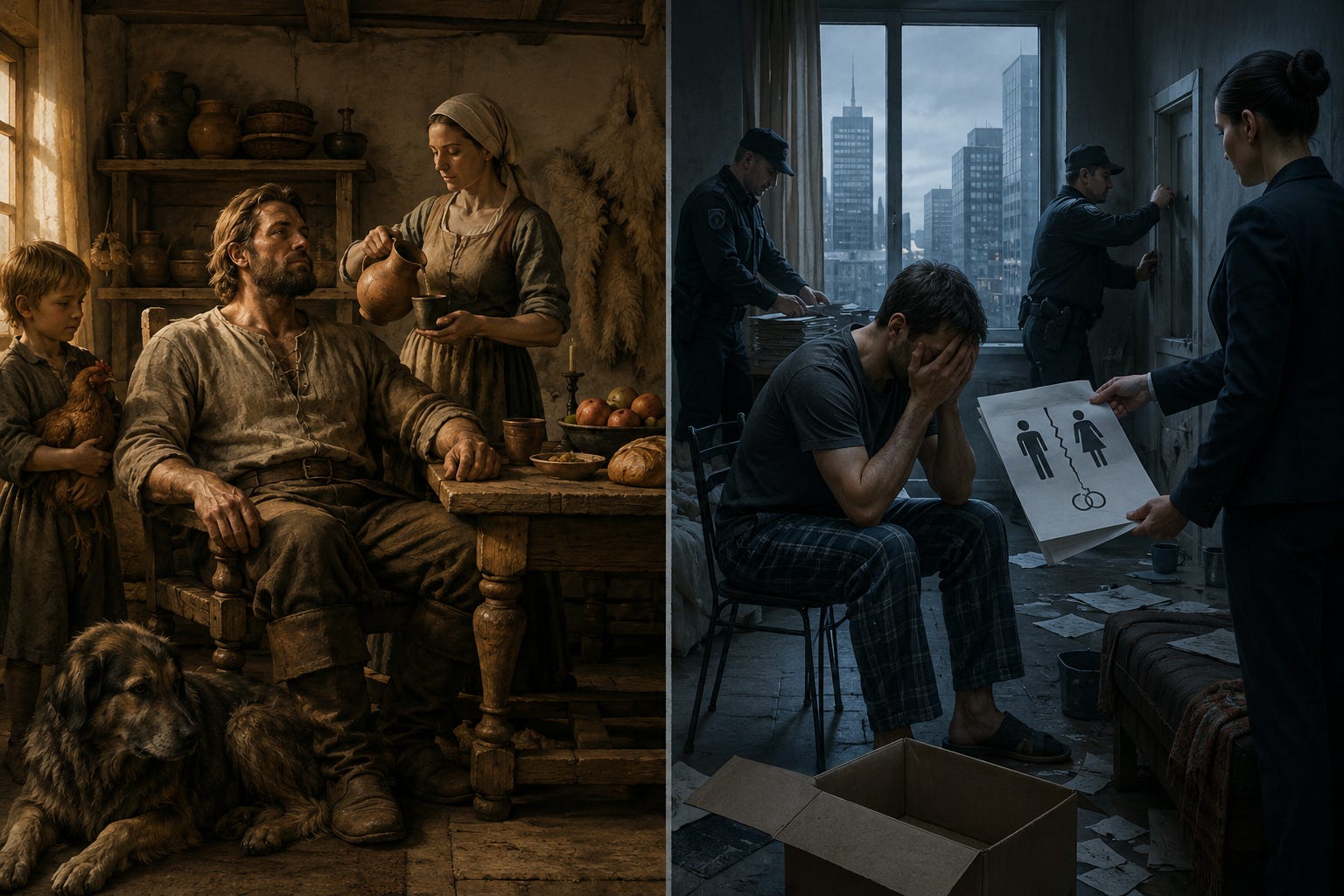
This blog routinely touches on the Village Life of the common man from Spain to Russia, Scandinavia to Merry Old England, and how it often appears to the Modern as a form of Utopian Socialism, with even the French Socialists of the nineteenth century concluding the ideal society would be the Orthodox Mir that existed in late Tsarist Russia if not for the total lack of free love and adultery, with those dumb rules concerning marriage, mandatory Church attendance, hierarchy and early family formation totally getting in the way of Utopia. The core claim of liberalism is one of liberation, of freedom and liberty. As it plays out over time in reality, the one never-changing thread of liberalism is the push for liberty from one’s neighbor, the opposite of Village Life.
Its seed begins with the concept of Grace as experienced within early and even modern Protestantism, where “grace-filled” movements repeatedly cleave off of the greater group they were formerly part. As Luther broke off of Rome, so the Reformed of Calvin broke off from Luther’s group. As the Anglicans broke off Rome, so the non-Conformists broke off of Anglicanism. The non-Conformists would go on to repeatedly break into ever smaller groups in what makes up the milieu of American Protestantism, with both Great Awakenings birthing multiple splinter groups each dividing from each other. The Azusa Street Revival did the same, with some of her children describing it as the Third Great Awakening alongside the Latter Rain of the Spirit. With the growth of non-denominationalism, the penultimate end of this pattern, congregations individually divided with each other with no ties that bind any given local group to another. Now some Americans fed up with the continuous subversion that follows this constant splintering embrace the ultimate conclusion of this path, just the individual and his Bible with no connection to any group trying to live a life of faith together at all.
This parallels the path of liberalism, where the village life of our forefathers wholly replaced by the individual consumer model of Modernity. First came the breaking of extended family duties, enabling people to pursue their own self-interest over the collective that birthed them. This paralleled the breaking of local folk cultures that both the Republics of France and the US pushed. Parish life and the safety net it provided first got watered down to mutual aid societies. Mutual aid societies gave way to the consumer model of insurance. With liberal rights came the cessation of any duties to one’s forebears, one’s extended family, one’s neighbors, one’s brothers in the faith and now with no-fault divorce even one’s spouse. Freedom from any ties that bind promises the Liberal demon, a freedom of maximum liberty for the individual to choose whatever he may choose.
Part of Britain’s jealousy of Russia was the Tsar’s and the Church’s ability to hold the Rus together, whereas the British routinely gave up her AngloSaxon children, be it from having no choice in the matter via force like America or having no choice from an imperial and financial viability standpoint with Canada, Australia and New Zeeland. All five nations are the furthest along this liberal path, a consequence of the breakdown in the ties that bind being the inability to enforce borders. The Irish as a whole are behind the AngloSaxon on this path, ergo the reaction to mass migration and the associated brutality of the invaders that fired off in Ireland that simply does not in England nor any of her children.
Liberalism permeates even what the Modern AngloSaxon would consider right-wing, with much of the homesteader movement unfortunately rooted in a desire to be free of one’s neighbors, to be wholly self-sufficient on one’s own. While some of the return-to-land movement indeed have the right idea of building communities that live life together, the general focus tends to reflect the same goal of many older folks have with their 401k’s, the desire to walk away from everyone and everything to do whatever one wants to do. Liberalism’s rejection of ties-that-bind underlie the phronema of both. A simple test to determine the heart of one’s desire for homesteading, retirement or rural life is to ask the question if you are moving away from somewhere, or are you moving towards somewhere? The same goes with jumping from one religious life or tradition to another, are you moving towards what you truly want to join, or are you merely leaving something you don’t like? Religious life is communal, from the Southern potluck after a Baptist service to the Trapieza after a Divine Liturgy, real religiosity is always expressed communally. Are you pursuing participation in that communal life or are you driven by individual preferences? If the former, the odds of you sticking with a major faith jump skyrocket.
Even America’s Founding Father’s knew that “we must, indeed, all hang together, or, most assuredly, we shall all hang separately.” The common Orthodox phrase “we go to heaven together and hell alone” captures this same underlying fundamental law of God’s creation that underlies the familial, cultural, religious and political spheres. True freedom exists solely in submitting oneself to a greater whole that creates the environment that enables the one to thrive. A wife submitting to her husband who built a home for her to flourish and be the familial heart is far freer than the Strong Independent Boss Babe approaching retirement age. A son living in his father’s house building skills and stacking cash to build his own future home instead of grinding to earn just enough to pay rent to Wall Street is far freer than those “liberated” at eighteen. A monk living a life of prayer in Valaam monastery under obedience to the abbott is freer than the Evangelibro frustrated that every church community he joins keeps getting subverted the same way over and over again. A serf who ruled his own house who in turn submitted to the King or Tsar was far freer than the modern free voting man who quite often finds himself served divorce papers with as much say in the matter as he does at the ballot box.
Beautiful piece today
I noticed a while ago that there had been a sea change in the common ambitions of my peers. When I was a child, we all spoke of getting into business, building wealth, having a posh pad in London, etc. It was all aiming to do something, to build something, etc. Now everyone is looking to retreat to a small cottage in the corner of a neglected wood, grow vegetables and speak only to the postman.